

Recommended Hob and Hood in Singapore
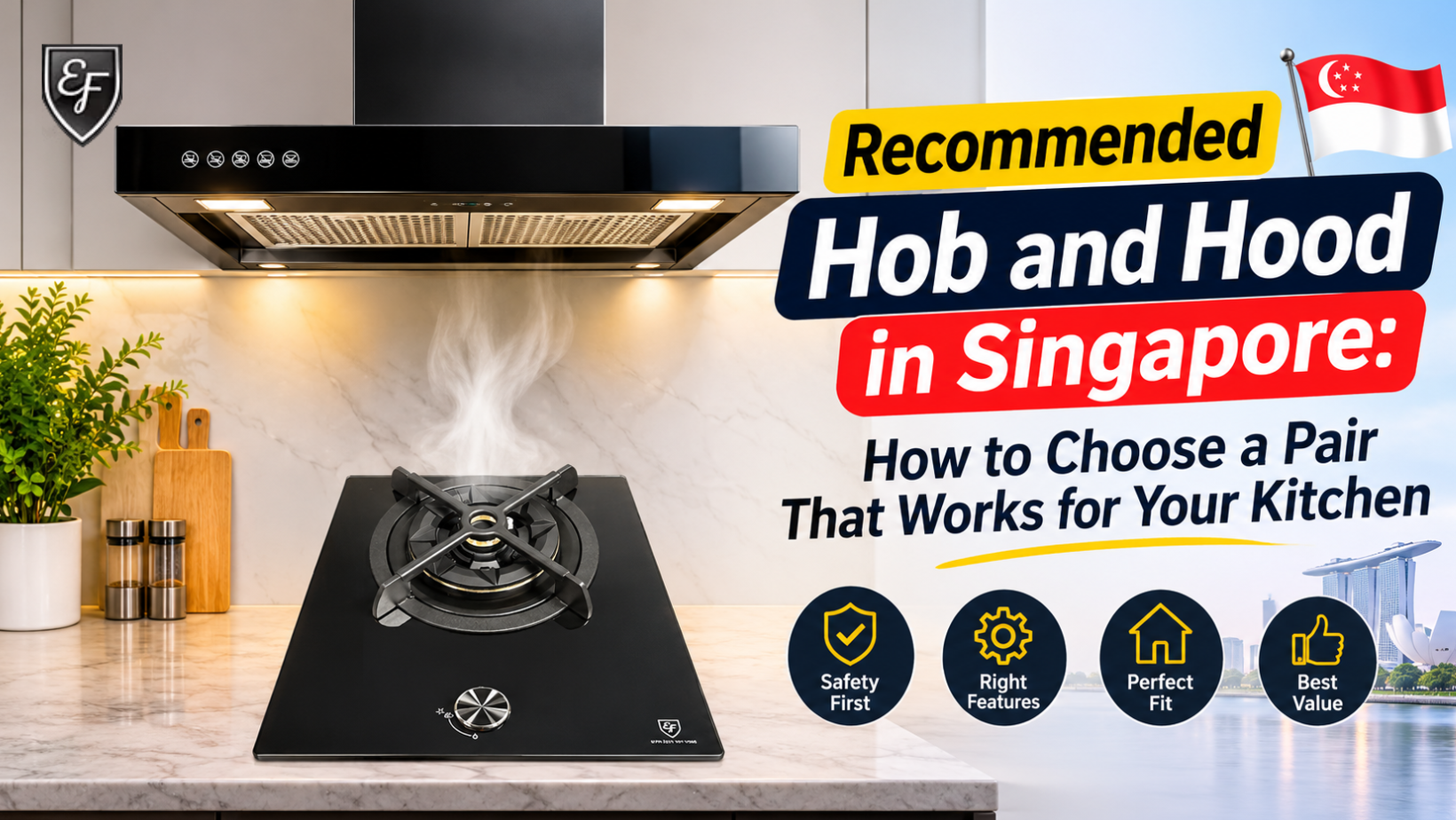
Why the hob and hood should be chosen together
Most Singapore homeowners pick a hob first and treat the hood as an afterthought. That is how you end up with a lingering smell of sambal in the living room, or a hood that is too small for a wok burner. A hob produces heat, steam and grease. The cooker hood removes them. If one is mismatched, the other cannot make up for it.
Singapore kitchens add their own challenges: heavy frying and wok cooking, high humidity, compact HDB and condo layouts, and often a semi-open or open-concept design where cooking smells travel quickly. This guide helps you build a shortlist before you look at specific models.
Step 1: Decide on your hob type
Gas hob. Strong flame control, works well with woks, and keeps working during a power trip. It needs a gas connection (town gas or LPG, depending on your home) and installation by a licensed gas service worker.
Induction hob. Fast heating, easy to wipe clean and no open flame. It needs induction-compatible cookware and a suitable electrical supply. Higher-power models often need a dedicated circuit, so check with a licensed electrician before ordering.
Ceramic or radiant hob. Less common now, slower to react and usually less energy efficient than induction.
If you cook wok-style dishes several times a week, many households prefer gas or an induction hob with a dedicated wok zone. If you cook lighter meals and value easy cleaning, induction is a strong fit.
Gas vs induction: what daily life looks like
Gas. You see the flame, adjust heat instantly and can use any cookware. The trade-offs are more cleaning around burners and pan supports, and extra heat released into the kitchen, which matters in a warm climate.
Induction. The surface stays cooler than a gas flame, the top is smooth to wipe, and boiling is quick. The trade-offs are the need for compatible cookware, a suitable electrical supply and, for some users, a short adjustment period with the controls.
Neither is universally better. The right choice matches your cooking style, your cookware and your home’s supply. If you cannot decide, visit a showroom and compare both in person.
Step 2: Match the hood to the hob
A good hood is judged on three things:
- Extraction rate (m³/h).Higher is better for heavy frying. Check the rated airflow at normal use, not only the boost figure.
- The hood should be at least as wide as the hob. A slightly wider hood captures more rising steam.
- Noise level (dB).A powerful hood that is unbearably loud will not get used. Look for the stated sound level at the speed you will actually use.
Ducted vs recirculating. Ducted hoods vent outside and remove smoke and moisture completely. Recirculating hoods rely on carbon filters, which need regular replacement and are less effective with heavy frying. If your unit allows ducting, it is usually the better option for Singapore cooking.
Reading extraction numbers in a real kitchen
Extraction rates on a spec sheet are measured in controlled conditions, so real performance is usually lower once ducting bends, kitchen layout and open windows come into play. A long, bendy duct run loses airflow. An open-concept kitchen needs extra capacity because smoke has more space to spread before it reaches the hood.
As a practical approach, choose a hood with comfortable headroom above what you think you need, then run it at a moderate speed for everyday cooking. That keeps noise down while leaving boost power for a heavy stir-fry. Always compare models on the same measurement basis, and ask the retailer how the figures were tested.
Step 3: Pick the hood style that fits your layout
- Chimney or wall-mounted:good for kitchens with a wall behind the hob.
- Slimline or built-in:blends into cabinetry, suitable for smaller kitchens.
- Island hood:for island hobs. It needs a higher extraction rate since there is no wall to guide airflow.
Browse the full cooker hoods collection to compare styles, widths and extraction ratings side by side.
Step 4: Check clearances and installation
Manufacturers specify a minimum distance between the hob and the hood, and it differs between gas and electric hobs. Follow the product manual. Poor clearance affects both performance and safety. Always use qualified installers for gas and electrical work, and share the hob cut-out and hood dimensions with your carpenter early so cabinets are built to match.
Quick recommendation framework
Your kitchen | Suggested direction |
HDB, enclosed kitchen, light to medium cooking | Induction hob plus slimline or chimney hood |
HDB or condo, frequent wok cooking | Gas hob (or induction with wok zone) plus high-extraction chimney hood |
Condo with open-concept or island layout | Strong, quiet ducted hood, sized wider than the hob |
Small kitchen, limited wall space | Built-in or slimline hood with compact hob |
Keeping your hob and hood performing
A hood that is never cleaned slowly loses performance, and grease build-up is also a fire risk. A simple routine helps:
- Wipe the hob surface after every cooking session while it is cool.
- Wash metal grease filters on the schedule in the manual.
- Replace carbon filters on recirculating hoods when the manufacturer advises.
- Check gas burners for blocked ports and clean them as the manual describes.
- Avoid abrasive pads on glass or stainless steel unless the manual permits them.
What to check at the showroom
If you can visit a showroom, check these details in person:
- Ask to hear the hood at low, medium and high speeds.
- Build quality.Look at panel thickness, knob feel and pan support stability.
- Height and reach.Check that the hood sits comfortably above your head and the controls are easy to reach.
- Filter access.Make sure you can remove filters without struggling.
- Check that the lights illuminate the whole cooking surface.
Bring your cookware dimensions and your kitchen layout. It makes the conversation with the sales consultant far more useful.
Plan the hob layout around your cookware
Before you pick a hob, look at the pots and pans you actually use. A family that cooks with a large wok, a stockpot and two frying pans at the same time needs more than two burners or cooking zones, and enough spacing so the pots do not collide. A couple who mostly uses one pan at a time can happily choose a compact two-zone hob and save counter space.
For induction, check the zone sizes and whether zones can be combined into a larger flexible area for oval roasting pans and griddles. For gas, check burner power and where the largest burner sits. A high-output burner placed at the back may be awkward to reach, while one at the front is easier to control but sits closer to children.
Budget, warranty and after-sales support
Price is only one part of the decision. A slightly higher upfront cost can work out better if it comes with a clear warranty, easy access to spare parts and a service team that responds quickly. Ask about warranty length, what it covers and how to book a service visit. For recirculating hoods, also ask about the cost and availability of replacement carbon filters, since you will be buying them regularly.
It also helps to think in terms of the whole set. Choosing the hob, hood and other built-in appliances from one supplier can simplify delivery coordination and make it clear who to call if something needs attention.
Common mistakes to avoid
- Buying a hood narrower than the hob.
- Choosing on looks and ignoring extraction rate and noise.
- Forgetting to confirm electrical or gas supply before ordering.
- Skipping filter maintenance.
- Ordering the hob without checking the countertop cut-out size.
- Leaving the order too late in the renovation, which delays carpentry and installation.
Frequently asked questions
Do I need to buy the hob and hood from the same brand? Not required, but matching widths and design lines gives a cleaner look, and one supplier can simplify warranty and installation.
Is induction safe for people with pacemakers? Follow the manufacturer’s guidance and consult a doctor. This is a medical question we cannot answer for you.
How often should I clean the hood filter? Metal grease filters are typically cleaned regularly, often every few weeks for frequent frying. Check your manual for the exact interval.
Where to go next
- Ready to compare specific options? Read our guide to choosing a hob and hood in Singapore, with installation and budget checklists.
- Planning a full kitchen? See how a built-in ovenand a steam combi oven fit into the same cabinetry, or read our best microwave oven guide.
- Need a recommendation for your home?Browse cooker hoods or contact our team for a free consultation.